|
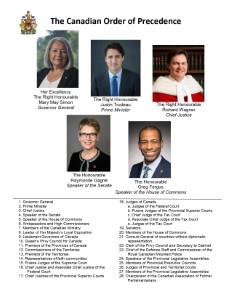
The order of precedence in Canada is a long established succession of power amongst virtually all of the government officials in Canada. Note that this is not an order of succession as does exist in the United States. If one or more of these officials becomes incapacitated or dies while in office, very little occurs in terms of the normal workings of the government. The only government post that must be filled is the Governor General, who signs bills into law, appoints various officials, and dissolves Parliament. However, the Chief Justice of the Supreme Court is automatically the Deputy Governor General who can fill in for the Governor General whenever necessary, and the Puisne Justices of the Supreme Court can fill in for the Chief Justice in a similar manner. The order of titles are listed below along with as many of the names as we could track down that correspond with the titles. The list was last updated on 24 April 2024. Please report any errors or omissions to this list. |
|
Surviving Spouses of Deceased Governors General of Canada
Former Prime Ministers of Canada
The Right Honourable Kim Campbell The Right Honourable Jean Chrétien The Right Honourable Paul Martin The Right Honourable Stephen Harper Former Chief Justices of Canada
4. The Speaker of the Senate
5. The Speaker of the House of Commons
6. Ambassadors, High Commissioners, Ministers Plenipotentiary
7. Members of the Canadian Ministry8. The Leader of the Opposition
9. The Lieutenant Governors of the Provinces of Canada
10. Members of the Privy Council11. Premiers of the Provinces of Canada
12. The Commissioners of the Territories
13. The Premiers of the Territories
14. Representatives of faith communities
15. Puisne Judges of the Supreme Court of Canada
The Honourable Suzanne Côté The Honourable Malcolm Rowe The Honourable Sheilah Martin The Honourable Nicholas Kasirer The Honourable Mahmud Jamal The Honourable Michelle O'Bonsawin The Honourable Mary Moreau 16. The Chief Justices of the Federal Court of Appeal and the Federal Court
17. Chief Justices of the Provincial Courts
The Honourable Michael Tulloch Quebec The Honourable Manon Savard Nova Scotia The Honourable Deborah Smith New Brunswick The Honourable Marc Richard Manitoba The Honourable Marianne Rivoalen British Columbia The Honourable Leonard Marchand Prince Edward Island The Honourable David Jenkins Saskatchewan The Honourable Robert Leurer Alberta The Honourable Ritu Khullar Newfoundland and Labrador The Honourable Deborah Fry Northwest Territories The Honourable Ritu Khullar Yukon The Honourable Leonard Marchand Nunavut The Honourable Ritu Khullar 18. Other Federal and Provincial Judges
b. Judges of the Federal Court of Canada c. Puisne Judges of the Superior Courts of the Provinces and Territories d. the Chief Justice of the Tax Court of Canada
19. Senators of Canada20. Members of the House of Commons21. Consuls General of countries without diplomatic representation
22. Clerk of the Privy Council and Secretary to Cabinet
23. Military Leaders
24. Speakers of Legislative Assemblies, within their Province and Territory
25. Members of Executive Councils, within their Province and Territory (excluding the Premiers)
26. Judges of Provincial and Territorial Courts27. Members of Legislative Assemblies, within their Province and Territory (excluding Premiers, Speakers, and Members of the Cabinet)
28. President of the Canadian Association of Former Parliamentarians
Notes1. The presence of the Sovereign in Canada does not impair or supersede the authority of the Governor General to perform the functions delegated to him under the Letters Patent constituting the office of the Governor General. The Governor General, under all circumstances, should be accorded precedence immediately after the Sovereign.2. Precedence to be given immediately after the Chief Justice of Canada to former Governors General, with relative precedence among them governed by the date of their leaving office. 2.1 Precedence to be given immediately after the former Governors General to surviving spouses of deceased former Governors General (applicable only where the spouse was married to the Governor General during the latter's term of office), with relative precedence among them governed by the dates on which the deceased former Governors General left office. 3. Precedence to be given immediately after the surviving spouses of deceased former Governors General referred to in Note 2.1 to former Prime Ministers, with relative precedence among them governed by the dates of their first assumption of office. 4. Precedence to be given immediately after former Prime Ministers to former Chief Justices of Canada, with relative precedence among them governed by the dates of their appointment as Chief Justice of Canada. 5. Precedence among Ambassadors and High Commissioners, who rank equally, to be determined by the date of the presentation of their credentials. Precedence to be given to Chargés d'Affaires immediately after Ministers Plenipotentiary. 6. This provision does not apply to such ceremonies and occasions which are of a provincial nature. 7. The religious dignitaries will be senior Canadian representatives of faith communities having a significant presence in a relevant jurisdiction. The relative precedence of the representatives of faith communities is to be governed by the date of their assumption in their present office, their representatives being given the same relative precedence. 8. This precedence to be given to the Chief of the Defence Staff and the Commissioner of the Royal Canadian Mounted Police on occasions when they have official functions to perform, otherwise they are to have equal precedence with Deputy Ministers, with their relative position to be determined according to the respective dates of their appointments to office. The relative precedence of Deputy Ministers and other high officials of the public service of Canada is to be determined from time to time by the Minister of Canadian Heritage in consultation with the Prime Minister. |